
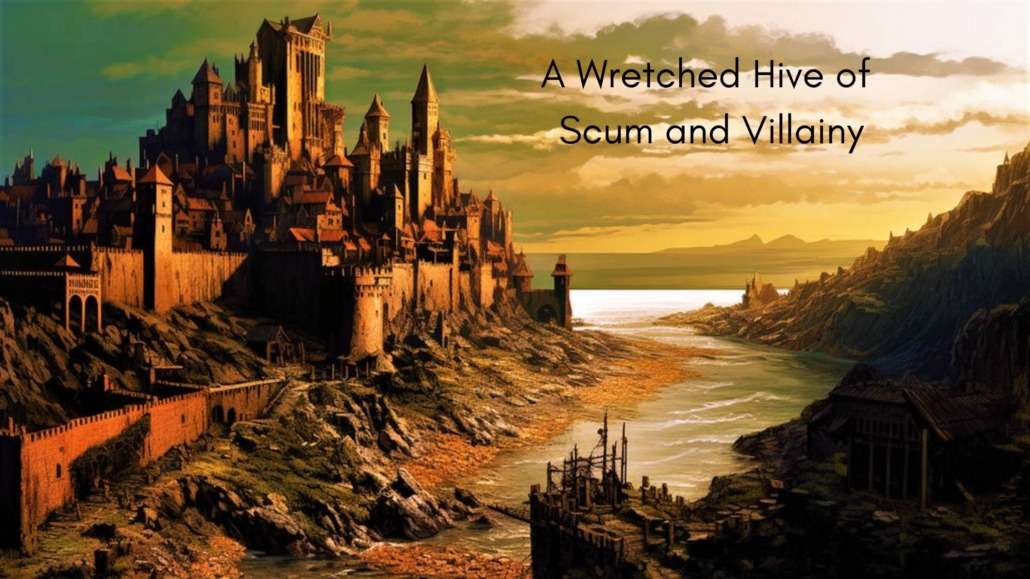
What A Game of Thrones Taught Me About Human Nature
Today I’d like to talk about a book that is near and dear to my heart. Though I can’t say it got me to write stories (Dune has that honor), A Song of Ice and Fire fascinated me with the telling itself. Never before had the way a story was told stood out to me the way this one did.
I’d never really thought about it before aSoIaF. Stories were just entertainment to me at that time, and not something I wanted to spend my life writing and reading great fiction. But I’m getting ahead of myself.
I first came across A Song of Ice and Fire more than a decade ago through the Game of Thrones TV show. The first three or four seasons were out when I first watched it. I was an impressionable teenager at the time, and this tale changed my outlook on a lot of things.
It was the first time I’d really gotten into the nitty-gritty of medieval politics, on top of the first story that really went against traditional structure.
Full spoilers ahead for A Game of Thrones.
The Execution that Changed Everything
When Ned Stark was executed by that little shit Joffrey (George R.R. Martin’s own words for him), my third eye was opened, as the three-eyed crow might say.
It was an awakening for me. The mad-lad Martin killed off his main character some 80 pages before the end of the first book! Off with his head, literally. The inciting incident in the series is the death of the main character. Now, I’m sure we’ve gotten to where that’s overdone and, in its own way, predictable.
But at that time, I’d never seen anything like it. How can you just do that and still have a story? Wait, the story gets better from here? Oh my. This is really something.
Far earlier on, Bran, a seven-year-old boy, is thrown from a tower and has his legs and hips shattered. He will never walk again. He will never have children. He’ll be crippled for the rest of his life because he caught twins having sex.
What is happening? Is this really a fantasy story? Yes. Yes, it is, and my kind of fantasy story, thank you very much.
Real Consequences in a Fantasy World
But this isn’t just misery and tragedy for their own sake, like a lot of imitators and lesser writers have done in the years since.
Cersei is the king’s wife. And Jamie is Lord Commander of the King’s Guard. They’ll both be executed if they’re caught doing what they’re doing. Not only that, but it would put their children into question. The whole reason “someone” killed Jon Arryn and got the whole story rolling in the first place.
This revolutionized how people see fantasy. This was unlike anything that had come before it, except for stuff like Black Company, which is way too dark for your average reader. Perhaps ASoIaF is too, but that’s a different discussion.
I see many people these days talking about how they miss the era of Tolkien. They miss their fairy stories, as he called them. To that I say, go write it yourself then. There is indeed an audience for traditional fantasy. But this is my shit right here. Dark, gritty, violent. I came up in the 2000s when we were getting movies like The Dark Knight.
Of course, when I was a child, I loved the Lord of the Rings films too. I’m sure we all did who grew up then. But this speaks to me on a far deeper, more visceral level. And it spoke to Joe Abercrombie as well, another one of my favorite authors who openly says Martin was instrumental in his own creative process.
His First Law and Age of Madness trilogies would not exist without A Song of Ice and Fire. And there’s plenty of other authors who can say the same, including me. My stuff would not exist the way it does without A Song of Ice and Fire. No question about that.
It has a rich narrative, deep characters, and is entrenched in real-world history. Martin clearly loves medieval England just as much as I love Imperial China.
I’ll freely admit I don’t like classic fantasy anymore. Then again, it might just be the hero’s journey I’m sick of. Anytime we have a village boy with a destiny to defeat the big-bad, I check out immediately. Dune probably ruined that for me, with its total flip on the prophecy trope. If you aren’t familiar, that prophecy is literally planted social engineering designed to control the populous, and has nothing to do with any actual future seeing.
It’s a control mechanism, nothing more. And our protagonist uses that mechanism to gain control. Ooh, so good.
The Tolkein Problem: When Good Men Rule
Tolkien unquestionably created the fantasy genre, though there were others in the early 20th century who had full alternate worlds, like Robert E Howard with Conan. He is the grandfather, and I can’t deny the sheer impact he’s had over the world of fiction evers since.
But Tolkien believed in a lot of strange things. You can say it was the time he lived in, but not everyone held his beliefs, even then. He believed in the medieval ideal where the king was appointed by god and ruled a just and noble kingdom. A king is the right form of government. He believed that a good man made a good king. And anyone who looks at history for any amount of time knows that’s simply a load of bullshit. Medieval propaganda, nothing more.
That’s something Frank Herbert understood. No wonder Tolkien “greatly disliked” Dune, which meant, because of how polite he was, he hated it. Because it spoke to something he wanted to deny. Power attracts the corruptible, as Herbert put it in a later book.
There are no real Aragorns. And the ones who are like him die because they aren’t as ruthless as the ones who want the power more than anything else in the world.
WWII would show us that. The Allies come together to defeat the Nazis, only to turn on themselves. Without the Russians, there was no victory, and look how wonderful their leaders turned out to be . . .
Martin might re-read LoTR every year, but Dune had just as big, if not a bigger, impact on him. I can’t blame the man; I became a novelist because of Dune.
What Happens After ‘Happily Ever After?’
Martin has talked about this, perhaps in a blog post. To paraphrase, “Okay, so Aragorn is a good man. But does that mean he’ll be a good king? Post-Lord of the Rings, what happens now? What was his tax policy? How did he deal with famine and drought? What did he do about all those orcs left in Mordor and the rest of the land?
Did he try to create some kind of mediation policy to try to integrate them into society, or did he have them all slaughtered? They’re a threat, after all. Even the children could grow up to threaten his and his children’s rule, not to mention the safety of the realm. What will the succession be? Will his kingdom of men accept a half-elf as their next king?”
Now, in Tolkien’s universe, the orcs truly are evil otherworldly beings. In real life, those defeated after the fall of Sauron are also people.
Robert Baratheon, the king of the seven kingdoms in the first book, is sort of his answer to that question. Robert was a great hero. 13 years before the first book (17 years in the show) he led a war against the Mad King Aerys. He was a warrior who led his men into battle with a massive warhammer. He slew the dragon prince and led the rebellion against the Mad King Aerys.
After years of strife, he becomes king, and he’s better than the Mad King by far. He was a great warrior, with songs sung of his deeds during his own lifetime. But Robert Baratheon is a shit king. He quickly devolves into alcoholism and indulgence and fathers a lot of bastards, bedding any woman he finds pretty, noble or peasant.
It’s not like anyone involved can say no. And the women we know of were more than happy to share their bed. He neglects all the administrative duties a king is supposed to preside over and leaves them to his council of vultures. Robert overspends, throwing the kingdom into tremendous, unrepayable amounts of debt.
That medieval ideal is a story that people told each other for generations upon generations upon generations. And then we get to modern-day people. It astounds me how many people say things about those in power like, “They can’t do that; it’s against the law.“ Or “the constitution” or whatever that nation has as foundational law.
I hope I’m not the first to bring this idea to your awareness, but if I am, happy birthday. If the people appointed to uphold and enforce the law don’t give a fuck, then the words on that piece of paper are only that. I don’t know why that’s so hard for some people to understand. Maybe they believe more like Tolkien did than Herbert, or something. Because I truly can’t grasp it. I don’t mean that in an insulting way; I just don’t comprehend that attitude.
Being upset and not wanting to allow bad behavior from those on top is one thing. But being outraged that they could do it in the first place misses the point entirely.
Look just about anywhere today, or at any point in history and you’ll see this is an indisputable fact. The people in charge make the decisions, not words written on paper by long-dead leaders.
Grimdark or Truth? The Purpose of Darkness
There’s an eternal debate as to whether fiction should always be positive and uplifting. There’s an argument about how things are too grim in the world as they are and fiction should exist to give positive messages.
A great example of a positive moral is Sylvester Stallone. He wrote Rocky and directed all those films himself. That whole franchise is about overcoming the odds and living your best life, no matter the challenge.
Rambo (at least the first one) is a tragic tale of a veteran plagued with PTSD, abandoned and neglected by everyone when he came home. At the end of the Rambo novel, the character is killed. The movie shot a version of the ending where that happened. Not only did test audiences hate it, but Stallone did too. He’s said he didn’t want to give the message that once you’re back from war, there’s no hope and you might as well just die.
That would be a TERRIBLE message!
Some say Martin’s work is just grimdark misery, but I wholeheartedly disagree. Perhaps that was part of Tolkien’s problem with Dune.
Yes, horrible things happen in A Game of Thrones, and way worse things in later books. I can’t speak about the book fans, but I know some show fans got all excited about the violence and brutality.
But Martin isn’t sitting there saying, “Look how cool all the blood, death, and misery is! Aren’t we having fun?” He’s showing us how horrible war can be, and how ruthless those who want power most will act to claim it.
I’ve even seen one argument that says, “Without offering an alternative to the really crappy feudalism idea, there’s no point.”
Well, what else is there? There are no good options. Communism is definitely not an option. All we need do is look at the 20th-century and we’ll find genocides far worse than anything Hitler attempted, done under the banner of communism. The polar opposite, at least according to modern ideals, is representative democracy. Look at modern-day USA and Europe. That doesn’t work either. It’s still just a small group of people making decisions that benefit them and theirs, everyone else be damned.
Full-blown democracy, where every citizen has the same say as everyone else, would never work because no one would ever agree on anything. Well, what about anarchism? That doesn’t work because on paper it sounds great, but so does communism. In practice, anarchism is what happens in a transitional period between one regime and the next. Anarchy doesn’t last very long. Soon, the people with the scariest, toughest friends, and the biggest, baddest weapons, take over. And now we have some form of dictatorial feudalism again.
I think he hasn’t offered us an alternative in these books because one, the other options suck too, and two because we aren’t at the end of the story yet. Whether that day ever comes is yet to be determined. As a fellow writer, that’s all I’ll say on that for now.
Obviously, the show at the end probably spoiled what he’s going for, which is a council of nobles who vote for the next king. It’s not the greatest solution, but Westeros won’t ever have another Mad King Arys or Joffrey, as long as this new system stays in place.
Power, Rights, and the Illusion of Order
On a different, yet similar topic, I find the way Martin handles rights to be fantastic. It’s like George Carlin said; they’re just an idea. Like the law, funny enough. Rights exist when everyone involved agrees. And man, do these characters not agree. Robbert thinks he claimed the right to be king through battle. Viserys thinks he has the right to be king because his father was Aerys. Daenerys believes it’s her right to rule after his death because she’s the only living heir to the Targaryen bloodline. Funny how that works, huh?
Anyway, I’ve gone on long enough. I could continue, but this is getting pretty long.
If you liked my take on A Song of Ice and Fire, you’ll love what I’m working on next. My upcoming novel takes everything I learned from Martin’s brutal realism and Herbert’s political complexity and transplants it into a Song-Dynasty China-inspired world where a shinobi father hides deadly secrets, and a scholar daughter struggles between wisdom and violence. Want to read the first five chapters totally for free, plus updates on my next discussion? All you have to do is join my reader group here.


 Jeshua Hicks
 Jeshua Hicks
Leave a Reply
Want to join the discussion?Feel free to contribute!