
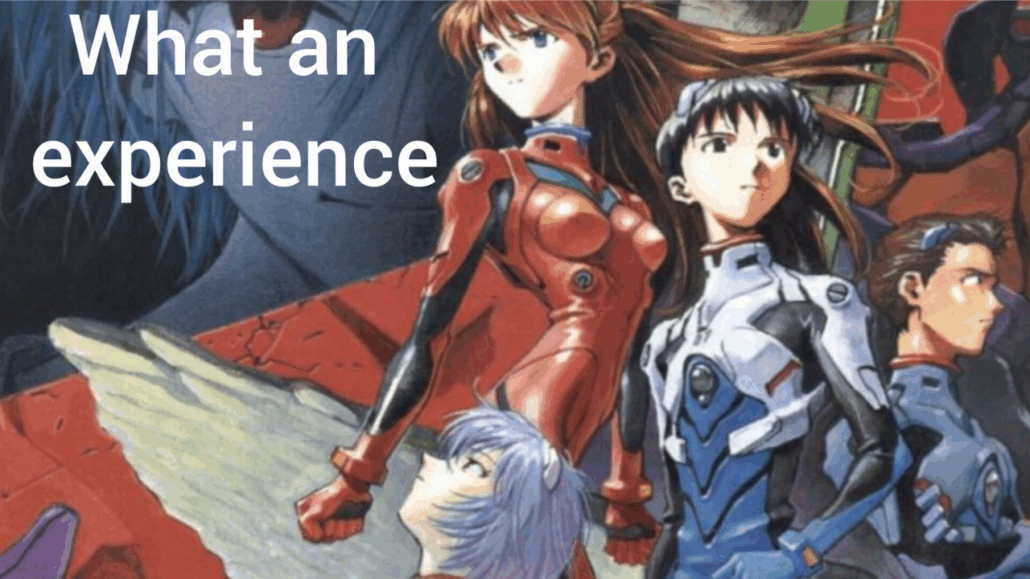
Whether you’ve watched the series or not, you’ve probably heard the name Neon Genesis Evangelion if you’ve hung out in anime circles for any amount of time. Because there’s always going to be somebody who says it’s the greatest thing that ever was. And I mean, I can’t really disagree.
There are definitely reasons people don’t like it. But I’m one of those people who do. I made my YouTube video about this earlier this year, shortly after watching it for the first time. I have a few months of hindsight now, and it’s still one of my favorite shows of all time. So recency bias isn’t as strong, for those who care about that in relation to favorite things.
This is me coming back and rewriting a video I made a while back. I think this version is better than my off the cuff ramblings, but here they are if you want to check out that version after you read this.
Spoilers ahead.
I rarely care for teenage protagonists. They’re usually written by adults who barely remember what it was like being a teen, and teens are cringey enough as it is. It’s also pretty silly to think that 14-year-olds are supposed to save the world.
But there’s something about Evangelion that’s different. Yes, it’s anime, and yes, it has a lot of the cliches that plague the art form even today. But the characters feel real. The world feels real, even though it’s fantastical, and high-concept.
Evangelion is mythic science fiction—it’s basically fantasy with a sci-fi veneer, which can be pretty fun, and it definitely works for Evangelion. And I buy that not only teenagers, but these specific ones, have to be the people to save humanity. It actually works here, somehow. I can analyze and point to some things that make it so, but there’s an intangibility to it as well. The vibe, the feeling. I keep coming back to the phrase, “It just works.”
To get this out of the way, I’m not talking about the rebuild movies in this analysis or deconstruction or conversation—whatever you want to call this—because I watched up to about halfway through the third movie in the rebuilds and I had to turn it off. It just wasn’t Evangelion. If you like those movies, more power to you. That third movie was just so not Eva that I had to turn it off. I may return to it someday, but not today.
It might be the original creator who made those movies, but he’s a very different artist at this point than he was in the mid-90s when he made Eva, and he does not have the same priorities, and I don’t like his newer stuff when it comes to Evangelion. I haven’t seen his other art, but this is about Neon Genesis Evangelion and End of Evangelion.
The characters are all horribly flawed, and I totally understand why so many people hate Shinji Ikari. The main character, our protagonist, is a whiny, depressed, submissive 14-year-old boy. And many people don’t like that. I don’t have a problem with him as a character. As a person, I would not want to spend any time with him. But that goes for a lot of the characters in this show. They all feel like real people, even though it’s anime from the 90s and the world they live in is nothing like the real world.
The people feel real. That can’t be said for a lot of anime.
My suspension of disbelief is totally suspended. I buy the decisions these characters make. And sometimes it’s not explained—often not explained—why a person does what they do. But that’s the case in real life. Most of the time, people don’t know why they do the things that they do, let alone other people.
So we have Misato who, oh my, say what you will about the Netflix dub, but her voice actor is just—I would so party with her. Specifically, the Netflix dub version of her. That voice actor is just so perfect, for me at least. I also prefer the English dub of Frieren over the Japanese for the same reason. There’s a maturity and texture that I simply adore. I could listen to either of those women talk all day.
Back to Misato herself. In End of Evangelion and even through the series beforehand, she does some questionable things with a 14-year-old boy. It’s questionable, but it’s in-character.
Our three main characters—the three 14-year-olds, Shinji, Rei, and Asuka—are all really messed up. Their childhoods weren’t really childhoods. They live in an alternate world where Y2K really was the end of the world. A horrendous event took place, and the world went in a very different direction than our real one.
This is just not a world where children get to grow up as children. They have to grow up quickly because things suck. The seasons don’t happen anymore. It is perpetual summer around the globe, at least in Japan, because the Earth’s axis got screwed up during this climactic event that destroyed the entirety of Antarctica when the first impact happened.
As for the plot itself, I have mixed feelings. Because it’s so ambiguous, and looking online, there’s so many fan theories and interpretations. External materials that were talked about by cast and crew and the writers in the decades since Evangelion came out have shed light on some things, but not others.
People have plucked and put together all these different things, trying to understand every detail and put the puzzle together. If you enjoy that process, theory crafting, awesome, have at it. Experience the media you enjoy, in the way you enjoy it. I know that’s blasphemy to some people, for some reason. It’s art! It’s entertainment.
Subjectivity.
It’s so crazy to think about subjectivity in art, right? We all know art is objective and there’s only one way to appreciate or understand it, right? Right? Moving on.
As a writer myself, I think I have some insights that might prove useful. Hideaki Anno, the lead writer, did not care about the plot and the world building. He’s gone on record and said that he used all that Christian symbolism because it looked cool. It’s not that deep. The last two episodes of Evangelion show us exactly what this show is about, and that’s the characters coming to terms with their varying forms of loneliness and depression. It’s little wonder why, since Anno was in a depressive hole when he made it.
Evangelion has so much EMOTION!
A moment that really struck me personally, because I’ve had a moment like this myself at a point in my life, was near the end of the series. Asuka, after having failed to pilot her Eva effectively for several missions, has been discarded by the NERV Project. We just learned that her parents had done the same thing through a whole tragic backstory I won’t get into here.
Nobody cares about her except her one school friend Hikari. She’s found an abandoned house and is just lying in an empty bathtub, staring at the rotted, blown-up ceiling. Asuka is completely empty inside, dead-eye staring at nothing.
Fuck.
That scene really hit me. It’s simple, easy. Just some stills, really. No crazy animation, no dialogue. Just a depressed girl staring at a half-gone ceiling. Between then and the backstory reveal in the previous episode, I went from hating every scene she was in, to her being my second favorite character, besides Misato. She’s annoying, and brazen, and hyperaggressive in every conversation she has, but we know why. The show managed to give me empathy for a character I despised. Rare is a show or book that can do that.
Another brilliant, truly brilliant, moment way earlier in the series is when Shinji rides the train. He’s unsure if he wants to quit NERV, because it’s brought him nothing but suffering. But his father runs the project, and his mom’s dead. Where else is there to go? Is Misato really his friend, or just using him to pilot the Eva?
The camera is in the ceiling, peering down on him as he sits, listening to his Walkman. There’s a group of people standing, several sitting. Then they fade out, and other people are onboard. Then others, until he’s all alone on the train and the announcement comes that it’s stopped for the night.
Again, a super low-budget scene. Literally just some cutouts placed on top of a rear panel with Shinji sitting there. But I could feel the emptiness, the nothingness inside as the despair overtook him. Talk about using your small budget to your advantage.
There are other scenes like that too. The one at the train station later comes to mind. Shinji decided he was done, that he’d leave and never come back. Misato realizes her mistakes and that he has friends here. She races to the station, only to get there right as the train pulls away. But Shinji never boarded. They lock eyes, and there’s at least a 30-second still of them just staring at each-other. No animation at all. A single frame with train station announcements and that all-too-familiar cicada call.
So much can be read from a still image.
What did I learn?
That brings me back to the title of this article, why it taught me to be a better writer.
If you’ve ever wanted to learn how to write your own story, you’ve probably seen the advice, “Make your characters suffer.” Push them to their limits and beyond. Neon Genesis Evangelion takes that a step further. Break them psychologically beyond the point that most other fiction has broken its characters. I mean, these people are shattered by the time the series nears its climax. Asuka is literally catatonic in the last episode before the movie. Shinji is almost that way himself, having had to kill the closest thing he’s ever had to a friend. And Rei is fucking dead, replaced by a clone who doesn’t know what she wants, but isn’t happy about the current arrangement.
The series starts out rather intensely. They get lighthearted in the second quarter, then it’s downhill from there. The physical and psychological danger grows and grows until it’s the end of the world, and the only people who can save it aren’t functional.
Obviously, there are stories that have gone darker that do worse things—Berserk, for one. I don’t know if anything gets darker and don’t want to find out. But at the same time, these characters, these children, are taken beyond the brink of insanity for a cause they barely understand.
There are several ways to interpret the endings of Evangelion. Yes, that’s endings, plural. The first ending is episode 25 and 26 of the show. This is a clip show filled with voice-over and narration, following the internal journeys of the characters and Shinji’s final decision, then a fade to white and it’s done.
I loved the final 2 episodes. They’re the only proof I need to prove my point that Anno didn’t care about the plot or world building. He cared about the internal struggles of his characters. It wrapped up the pieces that mattered most and dropped the curtain.
Well, many people don’t seem to understand that ending, then or now. Because people are still dissecting it for their readers/viewers, and Anno had to co back and make a movie to wrap it up differently. That’s right; End of Evangelion exists because the fans demanded it. Anno was perfectly pleased with the original ending.
Now here we are, two real-world years later, getting the external, plot-driven version of the ending.
The official canon says they exist in parallel. Two different endings with different messages, as far as I can tell. The rebuilds came in 10-20 years later (because the 4 movies took 10 years to make) and made a bunch of additions and turned everything into a time loop, with the OG series being the first iteration.
I like the version where episodes 25-26 happen inside End of Eva, right near the end when Instrumentality happens. There are a few minor issues with continuity, since the movie was meant to replace the last 2 episodes. But the realizations and message of those episodes shed a whole different light on the last minutes of End of Eva. It’s not the official canon, but that 2.5 hour experience of watching them together creates an experience like nothing else. A truly moving journey through pain, loss, and a sense of overcoming. That things aren’t ok, but that’s ok. They could be ok eventually.
Shinji and Asuka aren’t together, Rei is dead again, and who knows what the world will look like moving forward? I just love it. I don’t see why people wanted the rebuilds with their happy ending for everyone. Not everyone gets a happy wish-fulfillment ending. Sometimes surviving the battle and looking to the future is all you can do. It’s a melancholic end, yes, but perfect for Evangelion. A happy ending just feels wrong.
Maybe I’ll change my mind whenever I get around to watching the last 2 movies, but I really do love the ending we got in 1997.
Yes, we could have seen further in that process—in the healing process of Shinji and Asuka post everything—trying to figure it out, maybe getting along, maybe not. It’s again very ambiguous, and I love it. It’s great because depression doesn’t just go away; interpersonal issues don’t just get fixed with a quick apology.
Things are not always just better. Things can be okay. Sort of. And often that’s the best you can hope for in certain situations. With all that’s happened, being sort of ok is the most you could hope for. They’ll carry what happened for the rest of their lives.
As Frank Herbert said, the story never ends—it’s just where you end it. It’s the same with the beginning of a story. A story is always there. These characters can be as fleshed out and real as the creator of that story wants them to be.
I wonder how differently I would have done things had I watched it at a younger age. I can easily see it being a major cornerstone of my childhood, had I been that lucky.
The reason I really enjoy having the final two episodes mixed with End of Eva is because we get all the physical external drama of End of Eva and the cool fights and that last scene on the beach with the red ocean. The last two episodes are all about coming to terms with yourself. Living with yourself and with others, which clearly Anno was struggling with at the time. Shinji and Asuka and even Rei have hated themselves their entire lives, through no fault of their own.
They are products of their environment, like everyone is. Genetics and environment, woo. Shinji’s dad is Gendo Ikari, ffs. And they’re basically the same person. The worst-case scenario for Shinji when he’s grown up is becoming his dad.
The last two episodes are as Buddhist as it gets. We’ve been getting a lot of Christian symbolism through most of this, but now we’re going full Buddhism with the Human Instrumentality Project where everybody’s souls have merged into sort of a horrific—like cosmic horror Lovecraftian version of Buddhist enlightenment where everyone can see into the depths of everyone else’s souls. And as awful as it is, I totally see where those cultists were coming from. They believe the only way for humans to stop killing each other and hating each other and destroying ourselves is to force us to see it all. Push past the boundaries of this mortal coil. Break through the barriers keeping one mind from seeing the true depths of another. Instrumentality is about merging all of humanity into a single vast consciousness. And it pushes into perception of self and of reality and how none of us can really know anything.
There is a you within you, and there is a you that exists in your parents. There is a you that exists in the minds of your friends, of your enemies, of your lovers, of your haters. And all of those versions of you are just as valid as the you that exists inside your own mind.
I’ve seen some online saying there’s no real depth to any of this. People know this shit already. No, they don’t. Maybe you do, but you must have had a very strange upbringing if you’re aware of those things because most people never think about it like that.
And we aren’t just talking about it in some classroom somewhere. We’re experiencing these ideas through a story. Evangelion is ultimately a self-help process for getting over depression, and by the end, it’s not saying everything will be hunky-dory. Sunshine and lollypops. The world is fixed.
No, this is possibly a lifelong process of getting through this, or at the very least, it’s going to take a lot longer than it takes to get through 26 episodes and a movie. It will take months at least, maybe years . Some people spend their entire lives, and they never figure that lesson out.
Take Shinji. He hates himself, and because he hates himself, he thinks everyone else hates him. When people offer help, he thinks, “They’re just doing that because it’s the thing that’s expected of them.” This is Japan. There are a lot of social expectations in that culture. That’s true in every culture, but especially in East Asian ones. There are a lot of expectations of behavior. And so he thinks Misato is being nice to him because it’s expected, or because it gets him to do what she wants.
No, she’s being nice because she wants to help him.
That’s some perception is reality type stuff. How the inner workings of your own mind are the traps that leave you miserable. Happiness is a choice. As much as there’s a lot of visual Christian symbolism, it’s really a Buddhist tale.
So, yeah, Neon Genesis Evangelion. It’s some wild, dark, twisted stuff. I totally get why some people really don’t like it. There’s a certain allure to the rebuilds and a happy ending, but right now I’m perfectly content with the ending we got called End of Evangelion.
To those who have watched them and will say, “Oh, you haven’t experienced the real thing. You don’t have the real Eva experience until you watch them.” or “You aren’t a real fan if you haven’t seen the movies.“ I have this to say to you. The last Rebuild movie came out in 2019. Are you really saying Evangelion was incomplete for over 20 years? With nothing at all for ten? Even though we got the movie called End of Evangelion in 1997 and it won anime of the year, tying with Princess Mononoke? I think not, thank you very much.
I could keep blabbering, but I think I covered most of the core points I wanted to. It’s a journey. I put off watching it for so long. It was on my radar as something I knew I wanted to watch for probably a decade. And I kind of wish I’d watched it sooner, but at the same time, I wouldn’t have been able to follow all the Buddhist stuff if I did it before now.
It’s now one of my favorite shows. It’s great. I can’t recommend it to everyone. It is really twisted. There’s a lot of Freudian psychology in there for sure, especially with Misato, who herself points out that the reason she left Kaji was because she’d moved in with a boy who was essentially her father. So one of the characters even points out the Freud stuff.
If you’d like to see these lessons in action, you can get the first five chapters of my upcoming debut novel The First Ogre King for free when you sign up for my mailinglist here.
See you next time.


 Jeshua Hicks
 Jeshua Hicks
Leave a Reply
Want to join the discussion?Feel free to contribute!